Most shoulder surgeries are expected to complete their healing within 6–12 months. When pain persists beyond that point, it raises a legitimate question: is this still part of normal recovery, or is something wrong?
The honest answer: it depends. Some residual sensitivity is expected, especially after large rotator cuff repairs or shoulder replacements. But pain that limits your daily life, has not improved in months, or is getting worse — that needs attention.
Is It Normal to Have Pain 1 Year After Shoulder Surgery?
Research shows that recovery timelines vary significantly depending on the type of procedure. Studies on shoulder surgery outcomes consistently show that 10–15% of patients report ongoing pain 1 year after rotator cuff repair. The key distinction is not whether you have pain, but whether it is improving, stable, or worsening — and whether it limits your daily function.
What the research says about long-term pain
For shoulder replacements, mild aching and stiffness at 1 year is reported in up to 20% of patients and often continues to improve through year 2. Large and massive rotator cuff repairs have the longest recovery timelines — when a surgeon repairs a tear larger than 3 cm, the repaired tissue takes 9–18 months to fully mature and integrate with the bone.
Pain Expectations by Surgery Type at 1 Year
Common Causes of Pain 1 Year After Shoulder Surgery
Scar tissue and adhesive capsulitis
In some patients, scar tissue becomes excessive and restricts shoulder movement — a condition called adhesive capsulitis, or frozen shoulder. It affects approximately 5–10% of patients after shoulder surgery and causes deep, constant aching combined with significant loss of range of motion. It is treatable but requires diagnosis and targeted physical therapy or, in some cases, a procedure to release the adhesions.
Incomplete healing or re-tear
Re-tear is the most common structural complication after rotator cuff repair. It occurs in 5–40% of cases, depending on the size of the original tear. A re-tear does not always cause immediate dramatic pain — it can present as a gradual return of the original symptoms: weakness, aching, and pain with overhead activities. An MRI or ultrasound is needed to diagnose a re-tear.
Nerve damage
Some shoulder surgeries carry a small risk of nerve injury, particularly to the axillary nerve or the suprascapular nerve. Nerve recovery is slow — it can take 12–18 months for a nerve to regenerate along its full length. Pain with a burning, shooting, or electrical quality at 1 year may indicate ongoing nerve recovery.
Hardware irritation
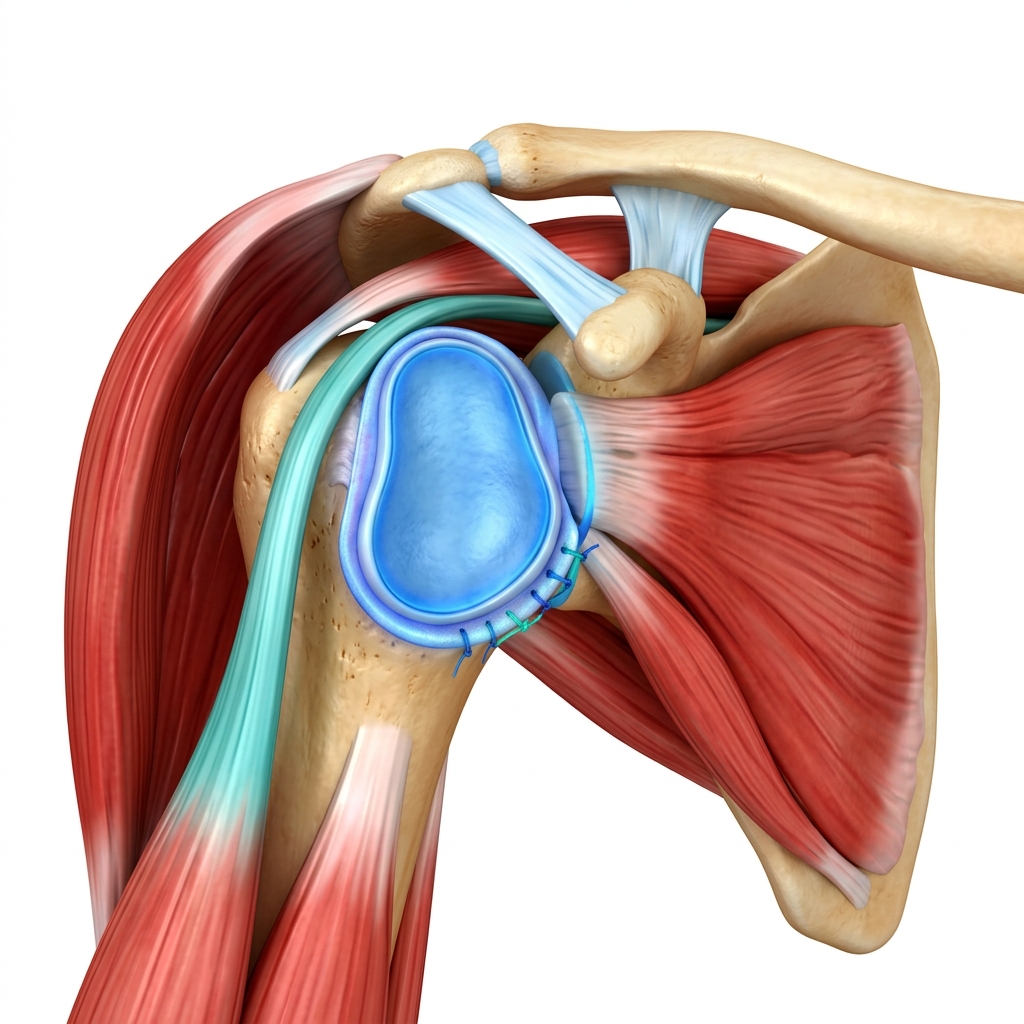
Shoulder repairs frequently use suture anchors or screws to reattach tissue to bone. In some patients, these anchors cause irritation at the repair site — called anchor impingement. It presents as a specific, localized pain that worsens with certain shoulder positions. This is identifiable on imaging and can be addressed with a minor procedure.
When to See Your Surgeon About Pain 1 Year After Shoulder Surgery
Make an appointment with your surgeon if any of the following apply at 1 year post-op:
- Pain is limiting daily activities — dressing, reaching, sleeping, or working
- Pain has not improved in the last 3 months — a plateau suggests an underlying issue
- Pain is worsening — any upward trend in pain at 1 year is concerning
- New weakness — particularly difficulty lifting your arm to the side or overhead
- Significant loss of range of motion — possible adhesive capsulitis
- Clicking, catching, or giving way — may indicate a re-tear or structural problem
Treatment Options for Pain 1 Year After Shoulder Surgery
Physical therapy
If imaging shows no structural problem, targeted physical therapy is the first-line treatment. A therapist with experience in post-surgical shoulder rehabilitation can identify specific muscle imbalances, movement compensations, and scar tissue restrictions driving the pain. This is different from early post-op PT — it is more advanced and focused on function restoration.
Cortisone injections
Cortisone injections can provide significant temporary relief — typically 4–12 weeks — for patients with persistent inflammation, adhesive capsulitis, or subacromial impingement at 1 year. They are not a permanent solution but can allow a window of reduced pain during which physical therapy is more effective.
PRP injections
Platelet-rich plasma (PRP) injections use concentrated growth factors from your own blood to stimulate healing in the repair site. Evidence for PRP in post-surgical shoulder pain is growing, particularly for patients with partial re-tears or areas of incomplete healing. Discuss with your surgeon whether PRP is appropriate for your situation.
Revision surgery: when is it needed?
Revision surgery is considered when imaging confirms a structural problem — such as a full re-tear, hardware failure, or significant adhesive capsulitis that does not respond to non-surgical treatment. Your surgeon will weigh the likelihood of improvement against the risks before recommending revision.
FAQ: Pain 1 Year After Shoulder Surgery