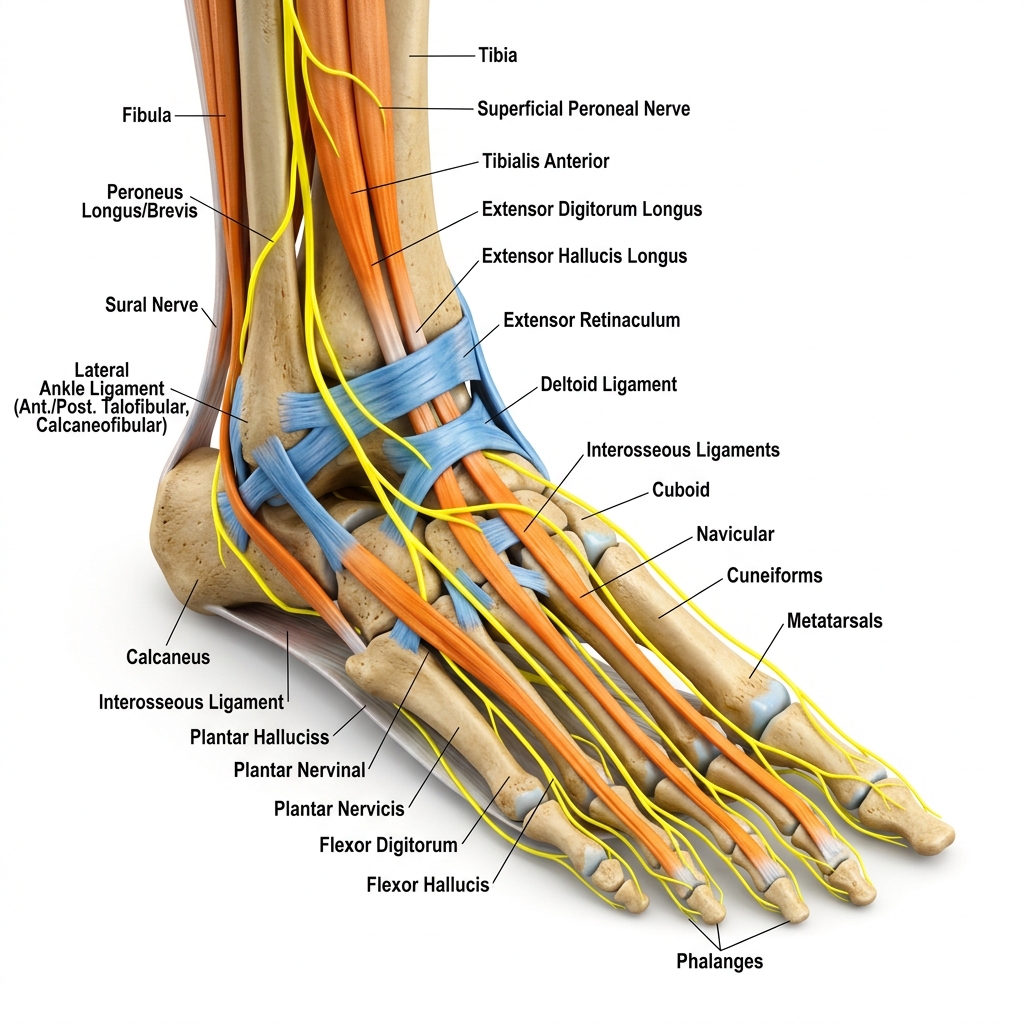
Nerve pain after foot and ankle surgery is extremely common — the foot has a dense network of small nerve fibers that are easily irritated by surgery and the post-operative swelling that follows. The good news is that with the right approach, most patients see significant improvement within 6–12 weeks.
How to Relieve Nerve Pain After Ankle Surgery
Ankle surgery — whether for fracture repair, ligament reconstruction, or joint stabilization — directly affects the nerves that run around and through the ankle. The sural nerve, superficial peroneal nerve, and saphenous nerve are most commonly affected. Here are the most effective strategies for relief.
How to Treat Nerve Pain After Foot Surgery
Why foot surgery causes nerve pain
The foot is one of the most densely innervated parts of the body. Every square centimeter of the sole contains thousands of nerve endings. Foot surgeries — bunionectomy, metatarsal osteotomy, plantar fascia release, Morton's neuroma removal — all involve tissue near these nerves. Post-surgical swelling in the confined space of the foot compresses these nerves, causing intense burning, tingling, and shooting pain that can be disproportionate to the size of the surgery.
Desensitization techniques
Desensitization is one of the most effective — and least known — treatments for nerve pain after foot surgery. The technique involves systematically exposing the hypersensitive area to different textures, starting with very light touch and gradually increasing stimulus:
- Start with a soft cotton ball — very gently stroke the painful area for 1–2 minutes, 3 times per day
- Progress to a soft cloth after 3–5 days
- Progress to a slightly rougher texture (terry cloth) after another 3–5 days
- Eventually work toward normal sock and shoe contact
This process retrains the nervous system to interpret normal touch as non-threatening. Most patients see significant improvement within 3–4 weeks of consistent desensitization practice.
Footwear and orthotics that reduce nerve pain
- Wide toe box — prevents compression of the metatarsal nerves. Avoid pointed shoes for at least 6 months after foot surgery.
- Cushioned insoles — reduce impact-related nerve irritation during walking. Custom orthotics may be prescribed by your surgeon.
- Metatarsal pad — if nerve pain is located under the ball of the foot, a metatarsal pad redistributes weight and reduces nerve compression at each step.
- Avoid bare feet on hard floors — the lack of cushioning significantly increases nerve pain in the early recovery phase.
How Long Does Nerve Pain Last After Foot and Ankle Surgery?
| Timeline | What to expect |
|---|---|
| Days 1–7 | Intense burning and tingling, especially when the nerve block wears off. Elevation is critical. |
| Weeks 1–4 | Nerve pain may fluctuate. Worse when standing or walking, better with elevation. Desensitization begins. |
| Weeks 4–8 | Steady improvement as swelling reduces. Tingling decreases. Weight bearing increases. |
| Months 2–4 | Most patients can wear normal shoes. Residual tingling and occasional shooting pain is common. |
| Months 4–6 | Most nerve pain fully resolved. Some patients have mild residual sensitivity around the incision. |
Nerve Pain in Foot & Ankle — Average Recovery
Warning Signs: When Nerve Pain After Foot Surgery Is Not Normal
- Complete numbness in the foot or toes that is not improving after 4 weeks
- New foot drop — inability to lift the front of the foot
- Nerve pain that is worsening rather than improving beyond week 6
- Fever above 101°F with increased redness or warmth — possible infection
- Severe burning pain that is unresponsive to all medications
FAQ: Nerve Pain in Foot & Ankle After Surgery