Hernia surgery — particularly inguinal (groin) hernia repair — is one of the most common procedures performed worldwide. It is also one of the most common causes of post-surgical nerve pain. Understanding why this happens, and what can be done about it, is essential for recovery.
What Causes Nerve Pain After Hernia Surgery?
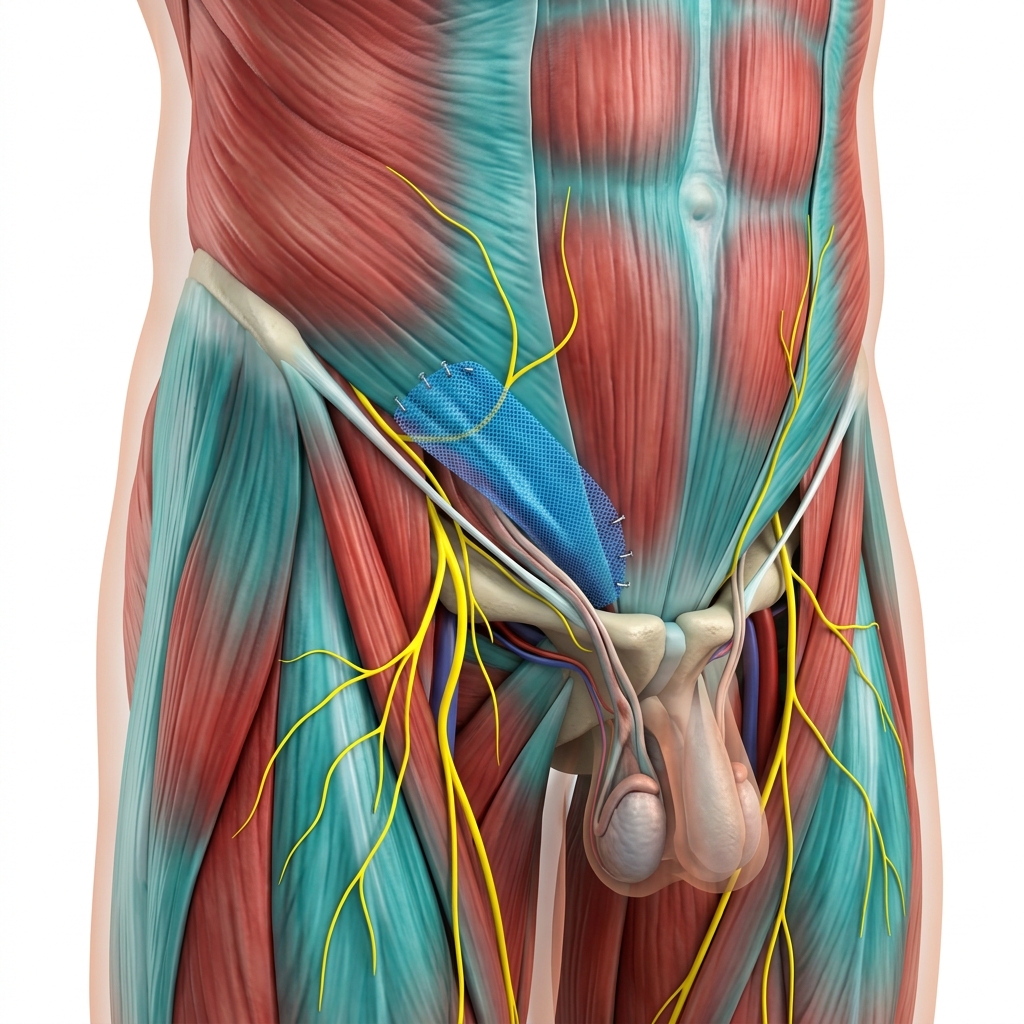
The three nerves commonly affected in hernia repair
Three nerves run through the inguinal (groin) region and are routinely encountered during hernia repair. Even a technically perfect surgery involves working in proximity to these nerves:
| Nerve | Location | Pain distribution |
|---|---|---|
| Ilioinguinal nerve | Runs through the inguinal canal | Groin, inner thigh, scrotum/labia |
| Iliohypogastric nerve | Runs above the inguinal ligament | Lower abdomen, groin, hip area |
| Genitofemoral nerve | Runs along the inguinal ligament | Scrotum/labia, inner thigh |
During hernia repair, these nerves can be stretched, compressed, or entrapped in sutures or mesh. Most of the time this causes temporary irritation that resolves within weeks. In a smaller number of patients, the nerve becomes permanently entrapped or damaged, leading to chronic pain.
Mesh-related nerve entrapment
Most modern hernia repairs use a synthetic mesh to reinforce the repair. As the mesh integrates with surrounding tissue over the first 3–6 months, it can occasionally contract or stiffen in a way that compresses nearby nerve fibers. This is more common with older mesh types and less common with the lightweight, flexible meshes used in most repairs today.
Mesh-related nerve pain typically begins 4–8 weeks after surgery — later than immediate post-surgical nerve irritation — and has a burning, constant quality rather than the intermittent shooting pain of acute nerve irritation.
Normal post-surgical nerve irritation vs. nerve damage
The vast majority of post-hernia nerve pain falls into the "normal irritation" category — the nerve is intact but inflamed. This type resolves within 3 months in most patients. True nerve damage — where nerve fibers are cut or permanently compressed — is less common and may require more aggressive treatment.
Treatment for Nerve Pain After Hernia Surgery
Medications: gabapentin, nerve blocks, NSAIDs
- Gabapentin (Neurontin) or pregabalin (Lyrica) — first-line medications for groin nerve pain after hernia repair. Take as prescribed; they require consistent dosing to be effective.
- NSAIDs (ibuprofen, naproxen) — effective for the inflammatory component of nerve pain in the first 4–6 weeks. Take with food.
- Acetaminophen — useful for baseline pain control, particularly at night.
- Topical diclofenac gel — applied directly to the groin, can provide localized relief without systemic side effects.
Physical therapy for groin nerve pain
Physical therapy after hernia repair focuses on:
- Scar tissue mobilization — gentle massage around the incision to prevent scar tissue from forming around nerve fibers
- Hip flexor stretching — tight hip flexors increase tension on the inguinal nerves
- Core strengthening — rebuilds the abdominal muscles that support the repair and reduces stress on the nerve-rich inguinal region
- Desensitization — reduces hypersensitivity in the groin area
When nerve block injections are used
If nerve pain persists beyond 6–8 weeks despite medication and physical therapy, your surgeon may recommend a selective nerve block injection. This involves injecting a local anesthetic and steroid directly around the affected nerve under ultrasound guidance.
A nerve block serves two purposes: it provides significant pain relief (typically 4–12 weeks) and confirms which nerve is causing the pain — useful information if further treatment is needed.
Surgical options: neurectomy for chronic nerve pain
If nerve pain persists beyond 6–12 months despite all conservative treatments, surgical neurectomy — removal of the affected nerve — may be recommended. This is a definitive treatment that eliminates the pain source. It results in permanent numbness in the nerve's distribution (groin, inner thigh) but most patients find this an acceptable trade-off for relief from chronic pain.
Neurectomy has a success rate of approximately 70–85% for chronic post-herniorrhaphy pain and is performed laparoscopically in most centers.
How Long Does Nerve Pain Last After Hernia Surgery?
Chronic Post-Herniorrhaphy Pain: When It Persists Beyond 3 Months
Chronic post-herniorrhaphy pain (CPHP) — defined as groin pain persisting more than 3 months after hernia repair — affects approximately 10–12% of patients after inguinal hernia repair. It is more common after open repair (Lichtenstein technique) than laparoscopic repair.
- Severe acute pain in the first week after surgery
- Pre-existing chronic pain conditions
- Younger age (higher baseline nerve sensitivity)
- Open rather than laparoscopic repair technique
- Prior hernia repair on the same side (revision surgery)
If you are experiencing groin nerve pain beyond 3 months, ask your surgeon for a referral to a pain specialist or a hernia surgery specialist with experience in CPHP. Early, targeted treatment significantly improves outcomes.
Warning Signs After Hernia Surgery
- Fever above 101°F with increasing redness or swelling at the incision — possible infection
- A bulge returning at the hernia site — possible recurrence
- Nerve pain that is worsening rather than improving beyond week 6
- Numbness spreading beyond the groin to the entire inner thigh or lower abdomen
- Severe testicular swelling or pain — possible hydrocele or testicular ischemia
FAQ: Nerve Pain After Hernia Surgery