How Long Does Testicular Pain Last After Inguinal Hernia Surgery?
Testicular pain after inguinal hernia surgery is one of the most common — and most alarming — post-operative complaints. Most patients are not warned to expect it, which makes it especially distressing when it occurs.
Normal testicular pain timeline: weeks 1–6
- Days 1–5: Aching and throbbing in the testicle, often more intense than the groin incision itself. Scrotal bruising and swelling is common.
- Week 1–2: Aching persists, especially when standing or walking. Scrotal swelling may peak around day 5–7 before beginning to resolve.
- Week 2–4: Steady improvement. Aching reduces. Swelling resolves.
- Week 4–6: Most patients are pain-free or have only mild occasional achiness.
- Month 2–3: Complete resolution in the vast majority of patients.
Why testicular pain occurs after inguinal hernia repair
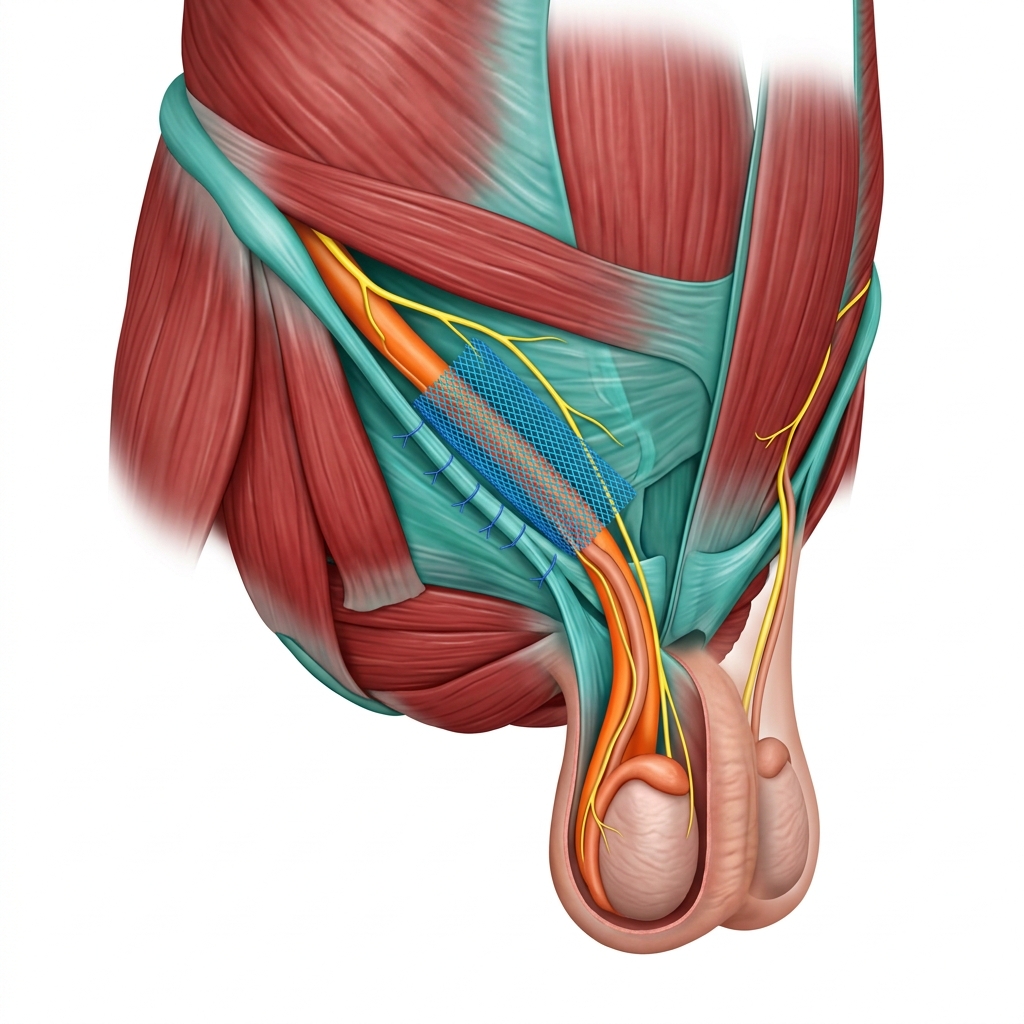
The spermatic cord — which carries blood vessels, nerves, and the vas deferens to and from the testicle — runs directly through the inguinal canal. During inguinal hernia repair, the surgeon must identify, retract, and work around the spermatic cord. Even with careful technique, this handling causes temporary inflammation and irritation of the cord structures, producing referred pain in the testicle.
Additionally, the genitofemoral nerve — which provides sensation to the scrotum and inner thigh — is one of the nerves most commonly irritated during hernia repair. Its irritation produces the characteristic aching, burning, or hypersensitivity in the testicle that many patients experience.
Testicle Pain 2 Weeks After Hernia Surgery — What's Normal
At 2 weeks, some degree of testicular aching and residual scrotal swelling is still normal. A hydrocele — a fluid collection around the testicle — can develop after inguinal hernia repair and causes the scrotum to appear swollen and feel heavy. Small hydroceles usually resolve on their own within 3–6 months. Larger ones may require drainage.
Normal findings at week 2: mild to moderate aching with activity, slight scrotal swelling, occasional shooting or burning sensation in the testicle, and sensitivity to touch in the groin and upper scrotum.
How to Relieve Testicular Pain After Hernia Surgery
Scrotal support and elevation
The single most effective measure for testicular pain is scrotal support. Wearing a supportive jockstrap or snug-fitting underwear (not loose boxers) reduces traction on the spermatic cord and dramatically decreases testicular aching. Wear supportive underwear 24 hours a day for the first 2–4 weeks — including during sleep.
When lying down, place a rolled towel or small pillow under the scrotum to keep it elevated. This reduces venous congestion and swelling.
Ice and pain medication
- Apply a cloth-wrapped ice pack to the scrotum for 15 minutes, 3–4 times per day during the first 2 weeks
- Acetaminophen (Tylenol) — effective for aching; safe to take regularly
- Ibuprofen (Advil) — reduces inflammation; take with food
- Avoid strenuous activity, heavy lifting, and sexual activity for the period recommended by your surgeon — usually 4–6 weeks
When nerve block injections are used
If testicular pain persists beyond 6–8 weeks and is significantly impacting quality of life, a genitofemoral nerve block — injected under ultrasound guidance near the inguinal ligament — can provide significant temporary relief and confirm nerve involvement as the pain source.
Warning Signs That Require Urgent Attention
- Sudden severe testicular pain — much worse than before, coming on rapidly
- Very hard, swollen testicle — possible testicular ischemia (loss of blood supply)
- Skin over the testicle that is hot, very red, or has dark discoloration
- Nausea and vomiting with severe testicular pain
- Fever above 101°F — possible infection
- Testicular pain that is clearly worsening after a period of improvement
- Rapidly increasing scrotal swelling beyond the first week
- A hard lump in the testicle that was not there before surgery
FAQ: Testicular Pain After Inguinal Hernia Surgery