What Causes Pulling Pain After Hernia Surgery?
Mesh tension and settling
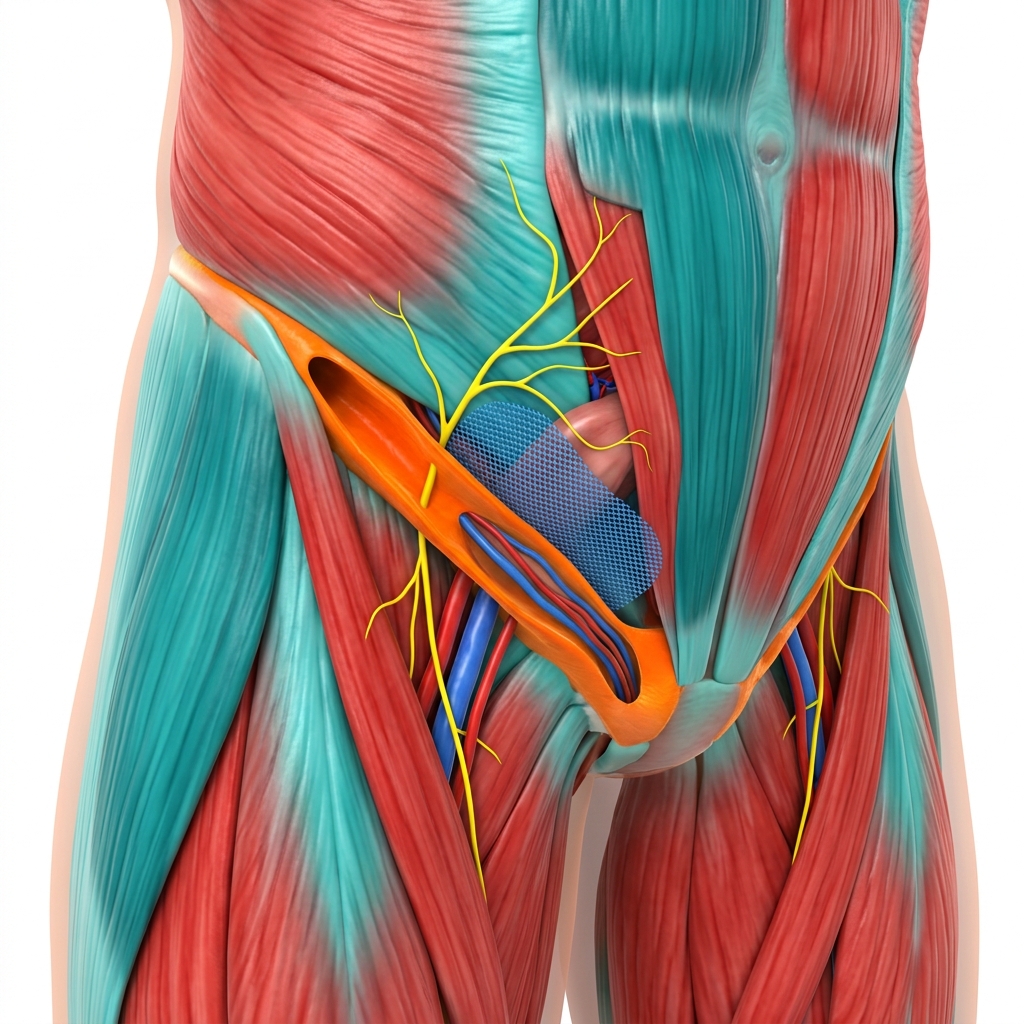
Most hernia repairs use a synthetic mesh to reinforce the abdominal wall. In the first 4–8 weeks, this mesh is not yet fully integrated into surrounding tissue — it is held in place by sutures and early scar tissue. As you move, bend, or stretch, the mesh creates a distinct pulling or tugging sensation. This is entirely normal and typically resolves as the mesh becomes fully incorporated and flexible — a process that takes 6–12 weeks.
Scar tissue formation
The body repairs the surgical incision by laying down collagen fibers — scar tissue. During the first 6–8 weeks, this scar tissue is still immature and stiff. It contracts slightly as it matures, creating a pulling sensation that is often most noticeable when standing up from a seated position, extending the hip, or walking upstairs.
Muscle guarding
The abdominal and groin muscles instinctively tighten around the surgical site to protect the repair. This protective guarding creates a constant tension in the groin that is felt as pulling. It typically resolves as pain decreases and confidence in the repair increases — usually by weeks 4–6.
Sharp Pain 2 Weeks After Hernia Surgery — Is It Normal?
At 2 weeks post-surgery, sharp pain with movement is very common. The incision is still healing, nerve fibers are hypersensitive, and the mesh is actively integrating with tissue. Sharp pain in response to sudden movements — standing up quickly, coughing, sneezing, or twisting — is expected.
Activities that typically trigger sharp pain at week 2
- Rising quickly from a chair or bed
- Coughing or sneezing without supporting the incision
- Bending at the waist
- Walking up or down stairs
- Any sudden twisting movement
Normal Pain vs. Warning Signs
- ✓ Pulling with movement or standing
- ✓ Sharp pain with coughing or sneezing
- ✓ Aching at the end of an active day
- ✓ Stiffness in the morning
- ✓ Mild bruising around the groin
- ✓ Scrotal swelling (first 2 weeks)
- ✓ Pain improving week by week
- ⚠ New bulge at the hernia site
- ⚠ Fever above 101°F
- ⚠ Increasing redness or warmth
- ⚠ Discharge from the incision
- ⚠ Pain worsening rather than improving
- ⚠ Constant sharp pain at rest
- ⚠ Nausea + severe pain (possible obstruction)
How to Relieve Pulling and Sharp Pain After Hernia Surgery
Rest and activity modification
The most important thing you can do in the first 2–4 weeks is respect the activity restrictions your surgeon gave you. Lifting anything heavier than 10–15 pounds, vigorous exercise, and sexual activity strain the repair and increase pulling and sharp pain. Gradually increase activity as pain allows — but do not push through significant pain.
Heat and gentle massage
From week 2 onwards, gentle heat applied to the groin and lower abdomen (not the incision itself) significantly reduces muscle guarding and the associated pulling sensation. A warm compress for 15–20 minutes, 2–3 times per day, is usually very effective. Gentle circular massage around the incision — not on it — helps soften scar tissue as it matures from week 4 onwards.
Pain medication options
- Acetaminophen (Tylenol) — effective for baseline aching and pulling pain; safe for regular use
- Ibuprofen (Advil) — reduces inflammation around the mesh and incision; take with food
- Stool softeners — constipation forces you to strain, dramatically increasing sharp pain; take a stool softener for the first 2 weeks
Pain Scale: Sharp & Pulling Pain After Hernia Surgery
FAQ: Sharp & Pulling Pain After Hernia Surgery