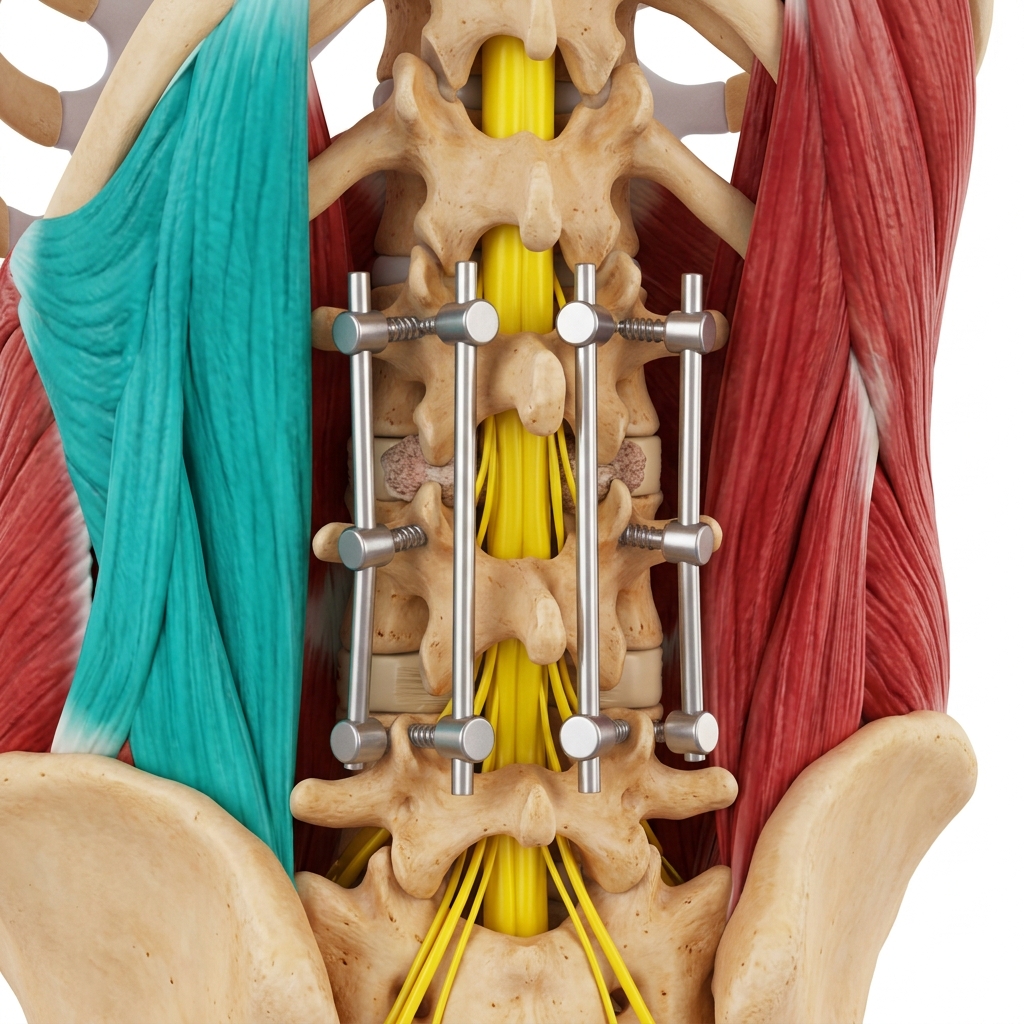
Many people are surprised to have leg and buttock pain after spinal fusion — especially if they had surgery to get rid of leg pain from a pinched nerve. This guide explains in plain language why the pain happens, how long it usually lasts, what you can do at home, and which symptoms mean you should call your care team.
What Causes Leg and Buttock Pain After Spinal Fusion Surgery?
Nerve root irritation during healing
Nerve roots are the nerves that branch off the spinal cord and travel down into your buttocks and legs. During a lumbar (lower back) fusion, the surgeon often frees nerve roots that were being pinched and then joins two or more vertebrae (spine bones) so they heal into one solid piece. To do this, the surgeon has to gently move nerves aside and work right next to them. That handling irritates the nerves for a while, even when the operation went well. An irritated, swollen nerve can send pain, burning, or tingling down the leg — similar to sciatica. In the first few weeks, this pain can feel as strong as your pain before surgery, and sometimes stronger. It usually eases as the swelling goes down.
The "awakening nerve" phenomenon
A nerve that was squeezed for months or years does not go back to normal overnight once the pressure is gone. As it recovers, it can become extra sensitive for a while. People often describe this as burning, shooting, "electric," or pins-and-needles feelings in the buttock or leg — sometimes in spots that did not hurt before surgery. In many cases, this is part of normal nerve healing rather than a sign of new damage, and it tends to be strongest in the first several weeks before it slowly settles down. Your surgeon should still check any new weakness, new numbness, or pain that keeps getting worse, because those can point to a different problem.
Muscle spasm and positioning
The paraspinal muscles are the long muscles that run along both sides of your spine. During open fusion surgery, they are held apart for a long time so the surgeon can reach the bones. Afterward, these muscles are often sore and tight and can go into spasm (sudden, painful tightening). That muscle pain can spread into the buttocks and the upper legs. A deep buttock muscle called the piriformis, which runs from the base of the spine (the sacrum) to the hip, can also tighten up. Because the sciatic nerve passes right next to it, a tight piriformis can cause pain that feels a lot like sciatica.
Scar tissue around nerve roots
Scar tissue is a normal part of healing after any surgery. In the spine, it can form around the nerve roots — doctors call this epidural fibrosis. In most people, it causes no trouble. In some, it keeps the nerve irritated, and leg or buttock pain lasts longer than 3 months. This is more likely after a repeat (revision) surgery and in people whose nerves were pinched for a long time before surgery. Scar tissue is only one of several reasons pain can linger, so ongoing pain should be checked by your surgeon.
How Bad Is the Pain After Spinal Fusion Surgery?
Spinal fusion is a major operation, and recovery is often more painful than people expect — especially during the first week. Your care team will give you pain medicine and help you get up and walking, usually starting the day after surgery. Some soreness in your back, buttocks, and legs is expected while you heal.
How much it hurts also depends on the kind of fusion you had. Fusing one level (two vertebrae) usually hurts less than fusing several levels. Minimally invasive surgery (MIS), which uses smaller cuts and moves less muscle, generally causes less pain after surgery than traditional open surgery. Your age, your health, how long you had pain before surgery, and how you respond to pain medicine also play a role.
Week-by-Week Pain Timeline After Spinal Fusion
| Phase | Timeline | What to expect |
|---|---|---|
| Acute phase | Days 1–7 | Strong back, leg, and buttock pain. Usually a hospital stay of a few days, with pain medicine by IV (through a vein) at first, then pills. Walking usually starts on day 1 or 2. |
| Early recovery | Weeks 1–3 | Pain slowly eases but can flare up for a day or two. Muscle spasms are often at their worst. Nerve pain may feel worse before it gets better. Short, frequent walks. |
| Nerve settling | Weeks 3–8 | Leg and buttock pain usually starts to go down steadily. Burning and shooting feelings become less frequent. You can walk farther. |
| Active recovery | Months 2–4 | Physical therapy often starts around this time if your surgeon recommends it. Many people return to light activities. Some aching after a busy day is normal. |
| Fusion consolidation | Months 4–9 | The bones keep knitting together into one solid piece. Pain keeps easing. Most daily activities are possible again, within your surgeon's limits. |
| Full recovery | Months 9–12 | Fusion is usually solid by now; full recovery can take up to a year. Many people have only mild pain or none. Some pain may remain, especially if you had long-term pain before surgery. |
Average Pain Scale After Spinal Fusion Surgery
How to Manage Leg and Buttock Pain After Spinal Fusion at Home
Walking — the most important thing you can do
Walking is one of the most helpful things you can do after spinal fusion. It keeps blood flowing, which lowers the risk of blood clots, keeps your muscles from getting stiff and weak, and supports healing. Many surgeons also believe regular movement may help keep scar tissue from binding the nerves. For the first 2 weeks, take short walks of about 5–10 minutes several times a day. Try not to sit for long stretches — get up and move around often. Over weeks 3–8, slowly walk a little farther each time, following your surgeon's instructions. If a walk clearly makes your leg pain worse, go shorter and slower for a few days.
Ice and heat
Ice helps most with swelling in the first 72 hours (3 days) after surgery. Use it for about 15 minutes, then take it off for about 45 minutes. After that, heat usually works better for tight, cramping muscles in the back and buttocks. Keep ice and heat off the incision (the surgical cut), and always put a cloth between your skin and the ice pack or heating pad. A heating pad on the muscles of the low back and buttocks — not directly on the spine or the incision — can ease muscle pain that spreads into the legs. Ask your surgeon when heat is OK for you, and never fall asleep on a heating pad.
Sleep position
Lying on your back with a pillow under your knees is often the most comfortable way to sleep, because it takes pressure off the low back and the nerves. Lying on your side with a pillow between your knees works well too. Most people should avoid sleeping on their stomach, because it arches the low back and can press on irritated nerves. In general, choose a position that does not make your back or leg pain worse. To get in and out of bed, "log-roll": keep your shoulders and hips moving together, roll onto your side, and push up with your arms.
Medication management
- Prescribed opioids — strong prescription pain pills such as oxycodone or hydrocodone. Take them only as prescribed, and cut back as soon as your pain allows, following your surgeon's plan. Don't drive or drink alcohol while taking them. They often cause constipation, so ask about a stool softener.
- NSAIDs (ibuprofen) — anti-inflammatory pain relievers such as ibuprofen (Advil, Motrin) or naproxen (Aleve). Ask your surgeon before taking them. Some surgeons limit these medicines in the first few months after fusion because they may slow bone healing.
- Nerve pain medication — gabapentin (Neurontin) or pregabalin (Lyrica) are often prescribed for burning or shooting leg pain after fusion. They can make you dizzy or sleepy. Take them exactly as directed, and don't stop suddenly without talking to your doctor.
- Acetaminophen (Tylenol) — often used every day for steady, background pain relief and generally safe when you stay within the daily limit on the label or from your doctor. Many prescription pain pills (for example, Percocet or Norco) already contain acetaminophen. Taking extra Tylenol on top of them can damage your liver, so check with your pharmacist first.
Warning Signs: When Leg Pain After Spinal Fusion Is Not Normal
- Loss of bladder or bowel control — for example, you can't pee, or you leak urine or stool without meaning to. This can be a sign of cauda equina syndrome, where the bundle of nerves at the bottom of the spine is badly squeezed. It is a surgical emergency.
- Sudden, severe new weakness in one or both legs, or you can't lift your foot or stand
- Saddle anesthesia — numbness in the areas that would touch a saddle: the groin, genitals, inner thighs, and buttocks
- Chills or a fever of 101°F (38.3°C) or higher, especially with more back pain — this can be a sign of infection
- A sudden, sharp jump in leg or buttock pain after it had been getting better
- New numbness, tingling, or weakness in your legs or feet that you did not have before surgery
- Redness, warmth, swelling, or fluid leaking from the incision — especially yellow or green drainage
- Back or leg pain that keeps getting worse and does not ease with rest and your prescribed medicine, including pain that is worse at night or when lying down
FAQ: Leg & Buttock Pain After Spinal Fusion Surgery