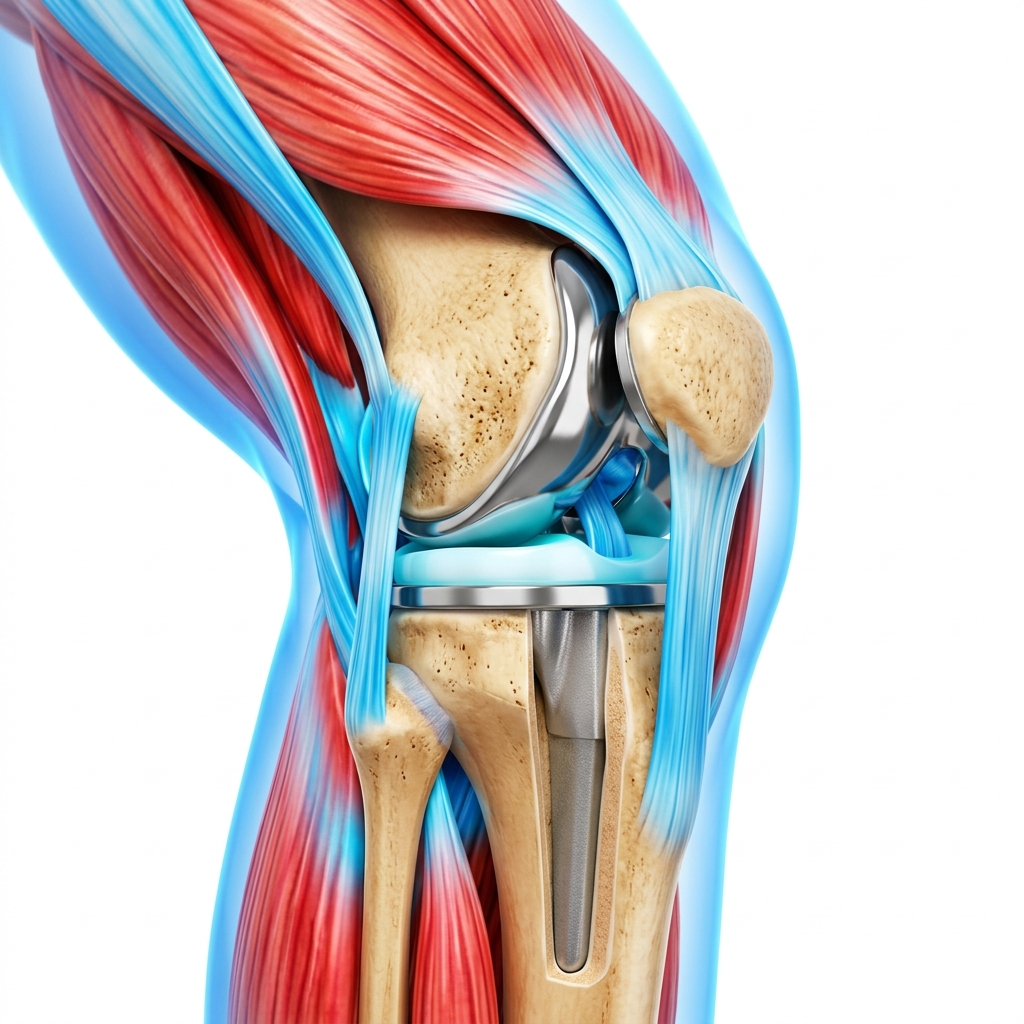
Knee replacement surgery replaces a damaged knee joint with a metal and plastic prosthesis. It is one of the most successful operations in all of medicine — yet recovery is longer and more painful than many patients expect. The honest truth: significant knee pain for 3–6 months after surgery is normal.
Knee Pain After Knee Replacement Surgery — The Honest Timeline
Week 1–2: intense post-op pain
The first two weeks after knee replacement are the hardest. The knee has been cut open, the joint surfaces removed, and metal components cemented or press-fit into place. Swelling is significant — the knee may be twice its normal size. Pain is intense, especially at night and during physical therapy. Walking with a walker begins on day 1. Pain is managed with a combination of opioids, nerve blocks, acetaminophen, and ice.
Week 3–6: PT pain and stiffness
The acute pain reduces but a new challenge emerges: physical therapy. Regaining range of motion after knee replacement requires bending the knee progressively further — a process that is uncomfortable, sometimes intensely so. The goal is 90 degrees of bend by 6 weeks. Stiffness — particularly after sitting or in the morning — is also very common and gradually improves over 3–6 months.
Month 2–6: rebuilding phase
By month 2, most patients are walking without a walker. Pain is primarily exercise-related at this point — soreness after longer walks, aching after PT, and occasional sharp pain with specific activities. Swelling continues to reduce. Most patients can drive by week 6 and return to desk work by week 4–6.
How Long Will I Have Pain After Knee Replacement Surgery?
| Timeline | Pain level | What helps |
|---|---|---|
| Weeks 1–2 | Severe (7–8/10) | Prescribed medication, ice, elevation |
| Weeks 3–6 | Moderate (5–6/10) | PT compliance, ice after sessions, walking |
| Months 2–4 | Mild–moderate (3–4/10) | Progressive walking, PT, acetaminophen |
| Months 4–6 | Mild (1–2/10) | Continued activity, strengthening |
| Months 6–12 | Minimal (0–1/10) | Most patients fully recovered |
What research says about 1-year outcomes
Large studies show that approximately 80% of patients are very satisfied with their knee replacement at 1 year. About 20% have some ongoing discomfort — most of these patients continue to improve through year 2. A small percentage (5–10%) have persistent significant pain that requires further evaluation.
Pain Scale After Knee Replacement Surgery
Warning Signs vs. Normal Symptoms
- Clicking, clunking, or popping with movement
- Morning stiffness lasting less than 30 minutes
- Soreness after PT sessions (resolving within 24 hours)
- Mild swelling that is worse at end of day
- Sharp pain when pushing range of motion in PT
- Fever above 101°F with increasing knee pain or redness
- Sudden significant increase in swelling after a period of improvement
- Feeling the knee has "given way" or is unstable
- Calf swelling, redness, or warmth — possible DVT (blood clot)
- Discharge or increasing redness at the incision
- Knee that locks and cannot be straightened or bent
FAQ: Knee Pain After Knee Replacement